
STEP 1: Be in a Calorie Deficit
CONSUME FEWER CALORIES THAN YOU BURN
By Chad | Updated 10/13/2025
Calorie Deficit is👑
There are so many fad diets out there.
-
- Low-Carb
- Intermittent fasting
- Carnivore
- Vegan
- See food (that was my uncle’s favorite)
- Low-Carb
But guess what: all of these diets work for the same reason. And no: it’s not related to insulin and brown fat storage. It’s simple:
Consume fewer calories than you burn, you will lose weight.
I can already hear your protests:
-
- “But wait, my friend says it’s all about sugar…” Sugar has a lot of calories. Cut it, and you’ll likely be in a calorie deficit.
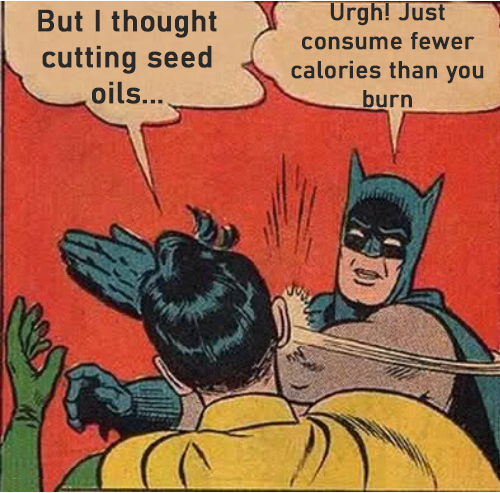
- “My friend says seed oils are…” Get new friends. No one learing to lose weight should even think about seed oils.
- “But what about a juice cleanse with extra…” I’m just going to stop you right there. Can you drink only juice the rest of your life?
Consume fewer calories than you burn. That’s IT! If you do that, you’ll lose weight. That’s the science, that’s the formula, that’s how all diets work. Someone who eats 1500 calories a day of cake frosting will lose the same amount of weight as someone who eats 1500 calories of lettuce. Period.
The Math
Here’s how it breaks down. It’s actually just a simple math equation. 1 pound is ~3500 calories. So let’s do an example.
- Sex: Male
- Age: 33
- Height: 5’9″
- Weight: 205
- Calories burned a day: 2000 (as an example)
- Calories consumed a day: 1500
How many days would it take him to lose 1 pound? I’ll show you the simple math.
-
- 2000-1500 = 500 – that’s his daily calorie deficit.
- 3500/500 = 7 days to lose a pound.
It will take him seven days.
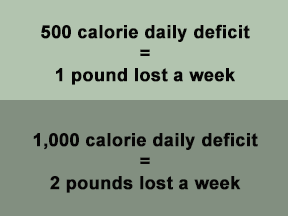
Put more simply:
-
- 500-calorie daily deficit = ~1 lb of fat-loss per week
- 1000-calorie daily deficit = ~2 lbs of fat-loss per week
⚠️Caution: Minimum Calorie Intake⚠️- Don’t eat too few calories. You want your body to be healthy and nourished. No two bodies are alike, so it’s nearly impossible to have exact rules. But, as a rule of thumb:
-
- Biological males – 1500 is the LOWEST you should go.
- Biological females – 1200 is the LOWEST you should go.
There are arguments to be made you can get enough nutrition at lower calories, and they’re good ones. But going any lower than those guidelines often leads to binging and hunger. We’re looking for sustainable life change here, so I recommend keeping above those minimums.
How Many Calories Should You Consume?
To know how many calories you should consume in a day, you have to understand your resting metabolic rate (RMR).
Your RMR is how many calories you burn a day without moving at all, just by existing. Your body burns calories just to maintain organs, to breath, to keep your heart beating, and to keep you alive. You burn calories in other ways too (more on that later), but this is a good starting point.
The below calculator will tell you approximately how many calories you burn a day before moving. Then, it will give you a recommended calorie intake per day as a starting point. This is calibrated to be accurate for you.
Put simply: Whatever the calculator says is the calorie-level I recommend to begin your weight-loss journey.
After you’ve been going a month and have lost at least 10 lbs, you can increase or decrease by ± 100 calories from what the calculator suggests (just remember the rule of thumb and don’t go below 1200 calories for women or 1500 for men).
Also, as you get smaller, your RMR decreases; so visit this calculator at least monthly during your weight-loss journey.
RMR & Calories Calculator
Estimate your starting calorie target for fat loss
RMR (Resting Metabolic Rate): —
Suggested Calorie Target: —
Aggressive Calorie Target: —
*Based on the the Mifflin-St Jeor Equation—one of the most accurate formulas available.
👉 Important:
Our calculator already takes these extra calories into account when recommending how much to eat. You don’t need to “add back” more calories based on how active you think you are.
Stick to your recommended intake and trust the process.
How Your Body Burns Calories
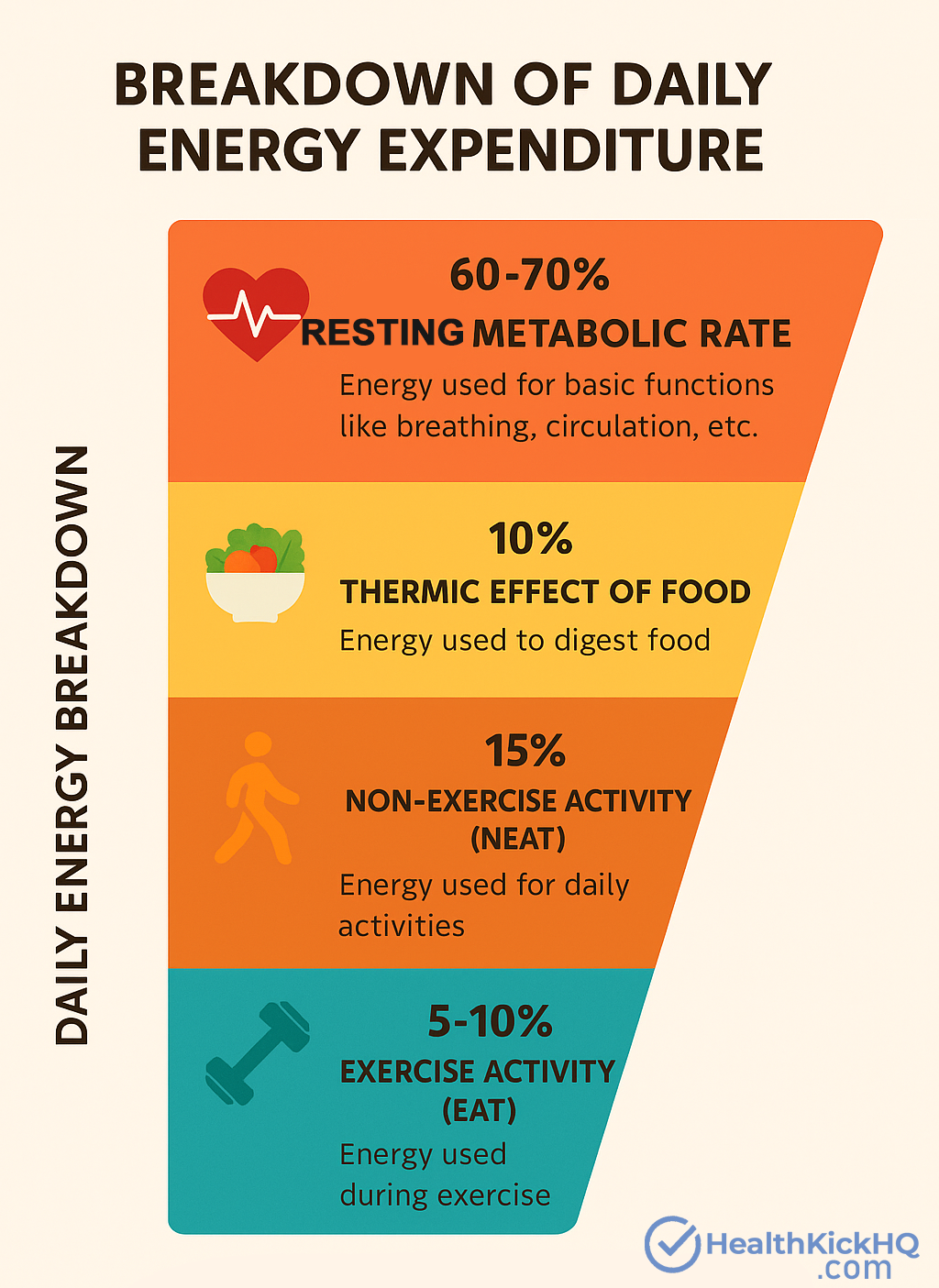
Here’s how your body burns calories:
🟥 60–70%: Resting Metabolic Rate (RMR)
Again, this is what you burn doing absolutely nothing, like breathing, circulating blood, keeping your organs going. This is your biggest calorie-burner by far.
🟨 10%: Thermic Effect of Food (TEF)
Yes, you burn calories just by eating. Your body uses energy to digest and absorb food; especially protein, which burns more calories to process than carbs or fat.
This is why some claim certain foods are better for weight-loss than others: your body expends more energy digesting them. It’s true: in Step 2 you’ll learn what types of foods to consume. But: since this is only 10% of your daily calorie burn, the difference it makes for pure weight loss is small.
🟧 15%: Non-Exercise Activity (NEAT)
This is stuff like walking around, doing laundry, standing, fidgeting, or chasing your kids. All your little daily movements count more than you think. That’s why I recommend at least 7,00 steps a day.
🟦 5–10%: Intentional Exercise (EAT)
Yup: your actual workouts are the smallest slice of the pie. Exercise matters for health and muscle, but you can’t out-train a bad diet. Most of your calorie burn comes from just being alive and moving throughout the day.
👉 Don’t increase calories if you work out
Unless you’re training for a marathon (or another endurance sport), you shouldn’t increase your calories much because you’re working out that day.
Sometimes you want extra calories for performance and/or energy. If you’re feeling sluggish during your rec basketball games, you can add 100-200 calories maximum.
But you can see, intentional exercise is at most 10% of your daily calorie burn.
What’s Next?
At this point, you know that if you consume fewer calories than you burn, you’ll lose weight. You also know how many calories to eat. Finally, you know how your body burns calories each day.
The obvious next question: “What should I eat?”
👉 Head to Lesson 2 →
📌Notes to Keep From This Lesson 📌
- Consume fewer calories than you burn, you’ll lose weight.
- My daily Calorie intake ________
The below calculator is to play with to see how fast you can lose weight. It’s just for fun and to see how much progress you can make.
Weight-Loss Pace Estimator
Estimate weekly loss from calories, exercise, and RMR
Trackbacks/Pingbacks